

Journey in the West - How Kung Fu Changed My Life
Updated: Feb 15, 2022
A Journey in the West: How Kung Fu Changed My Life
By Christopher Keddie

When I was asked to write this blog about my passion for the martial arts I had to try to think back to where it all began for me. If it's a simple story you want then I first began training in Karate in 2005. After a while I lost interest in Karate but took up training again in 2007 when I began studying Kung Fu (which is and always has been my true passion) and in 2016 I expanded my knowledge by taking up Filipino Martial Arts, better known as Kali/Arnis/Eskrima (all are accurate).
And that's it, end of story!
But of course, it's just not that simple. The truth is that martial arts has always had a presence in my life. I grew up in an age of Ninja Turtles, Karate Kids, and Power Rangers. The biggest arcade games during my childhood were games like Street Fighter II and Mortal Kombat*. I look back now on these cultural references with nostalgia, and a kind of joyous gratitude for having been a kid at such a time, something that each generation can relate to with memories of their own childhood, whatever decade they come from. But even though these memories stick in my mind, I can't really say that they contributed massively to my love of martial arts. As an adult I often wonder why this influx of material failed to ignite the spark that would literally change my life. I believe the answer is that after the initial Kung Fu mania that spread throughout the world in the 70's, the martial arts had now become a commercial commodity. The image of people doing high kicks and fancy gymnastics was fed into the psyche as a means of selling TV shows and video games to a young, impressionable audience. Realism was abandoned and the martial arts began to look comical and camp. In a word...fake!** Martial Arts had essentially become a pantomime. The true action heroes of the day were Arnold Schwarzenegger, Sylvester Stallone, and Dolph Ludgren. Power houses of muscle and testosterone with biceps the size of your head, who had little need of the martial arts when they could rely on brute strength***. After all, put Rocky Balboa in the ring with Daniel LaRusso and who would you bet your money on? (I think you'll need to wax a few

more cars, Daniel-San). Now, let me paint you a picture of young Christopher Keddie; skinny, gangly and physically awkward. I wore glasses too big for my head which always seemed to have a magnetic pull for flying footballs, so were often bound together with plasters. My hair was long and would often get windswept giving it the "just-got-out-of-bed" look 24 hours a day. I had wonky teeth that could only be corrected with braces, which basically felt like barbed wire in my mouth. I was tall for my age but skinny, something that I could not remedy by eating excessive amounts of cake or custard creams. Add to this the further verbal and physical deformities that result from becoming a teenager and I was as far removed from the action heroes that I so admired as a Goldfish is from the Great White Shark. I was, to put it mildly, a nerd! There comes a time in every child's life when the need to fit in overrides any sense of logic and reason. I was a social outcast and for the most part I felt no need to fit in. I did, however, grow tired of the constant name calling and being the punch line of someone else's joke. To say that I was bullied would be an unfair exaggeration, but it is true that a lot of people probably saw me as an easy target to laugh at. As this was mostly directed at the preconception that I was weak, I decided that I would redefine myself. So the glasses came off, the hair got cut, and I got a hold of some weights to start "pumping iron" +. The trouble is that a teenager's body is not really meant to be put under such stress whilst bones are still growing and so physically I really didn't change much. If I was going to sell the idea that I was tough I would need something else, an edge. Thankfully, the answer came one night whilst watching TV. With the 21st century looming on the horizon, BBC2 had begun a nostalgia trip of previous decades by running programmes around a certain theme over a number of weekends. These themes would consist of documentaries around that theme, one-on-one interviews with British celebrities who lived to experience those times, and usually a couple of films that epitomised the spirit of the times (or "zeitgeist" for those of you who studied media studies at school). BBC2 ran many of these weekends including one about Kung Fu. Saturday evening began with a comical retrospective of Kung Fu movies presented by Alexei Sayle, followed by a documentary about the cultural impact of Kung Fu on western society, beautifully demonstrated by the popularity of the hit single "Kung Fu Fighting" by Carl Douglas. But the real draw of the evening was the showing of a film I was only vaguely familiar with. The film was called "Enter the Dragon" and starred (in case you didn't know) the legendary Bruce Lee. The plot was relatively simple++ but within the very first 5 minutes of the opening of the film we get to see Bruce Lee's awesome speed and power and from that moment I was hooked. Bruce was strong and dynamic and yet his most appealing feature was that like me, he didn't fit the mould of your classic action hero. At 5'7'' Bruce Lee was the same height as teenage me (even now I currently stand at 5'8'') and though he had a muscular build he actually looks pretty skinny weighing around 130 lbs (I don't really recall my weight as a teenage but my current weight is only 177 lbs). In short, here was an action hero that I could relate to in some degree. This was the moment that martial arts would forever become a part of my life. The BBC2 weekend continued with a film called "The Prodigal Son", a typical Kung Fu
movie from Hong Kong (complete with dodgy English dubbing) starring another great martial arts legend, Sammo Hung. The whole weekend wrapped up on Sunday night with "Dragon: The Bruce Lee Story" starring Jason Scott Lee (no relation). Having watched the bio of his life, Bruce Lee became a somewhat mythical figure in my mind, an ideal to aspire to...and I was hungry for more. Fortunately, around the corner from where I lived the Post Office had a tiny stall which sold VHS movies for £5 each. With my weekly pocket money I would go around to the post office and pick up any video that related to Bruce Lee+* and pretty soon I had exhausted the post office's Bruce Lee collection. Like an addict I needed my fix, so I turned to other sources such as Jackie Chan, Sammo Hung, Bolo Yeung, Jean Claude Van Damme, Chuck Norris, Jet Li, Cynthia Rothrock, Richard Norton, and many more. Whenever a martial arts film hit the shelves it was mine, whenever a martial arts film was on TV it would be recorded to VHS and added to my collection. And my addiction didn't end with films, suddenly every visit to the high street would lead me to WHsmith to pick up the latest copy of Black Belt magazine and Martial Arts Monthly. And people were beginning to see a change in me and suddenly the word "nerd" got replaced with "Bad Ass" +** and I had not even had a single lesson. It would be several years before training would actually begin.
Despite what my school friends believed, I simply was not a "bad-ass" and was nowhere near ready to begin training in the martial arts. In those formative years I had created a persona, one built around the martial arts that fit in with my idealised fantasy of how I wanted to be perceived. The truth of the matter was that I simply did not want that fantasy to be shattered by having to face reality. To compare this to something you may be familiar with think of Kung Fu Panda (2008) where Po dreams of being a master martial artist and leader of the Furious Five, but when he begins his training he's clumsy and unfit and constantly ostracized by Shifu and Tigress for being fat and lazy. So I blissfully continued living my fantasy until we all grew older and suddenly being tough no longer seemed so important because a new distraction occupied my mind...women! Now I'm not saying I was ever a ladies man, but it seemed to me that Kung Fu no longer seemed so important compared to the opposite sex. Besides, my love for martial arts movies had extended to movies in general so that my new passion became cinema. But like a patient friend, the martial arts remained present just waiting for the day that I would be ready and I came back to it in the strangest of ways.
The year is 2003, I'm working in a dark and dusty warehouse where I'm also cold and the rain is pelting down on the roof just adding to the misery I feel at not having a direction in life. I know I want to work in TV and film so I've spent my gap year applying for work experience at production companies in the hope of one day becoming a video editor. Like most people, I have a huge pile of rejection letters with the primary reason for not getting a place as a "lack of experience". I decide not to go to University, feeling that the course that accepted me was not going to get me where I wanted to go. I had to make a choice fast because I didn't want to be cold and wet in a dark and dusty warehouse for the rest of my life. So, what was I going to do? In order to answer this question I asked myself what I would do if I could do anything. The answer surprised me, I would become an actor. Having never shown much interest in drama before I knew that the only way to begin was to enrol in drama school, so after getting a subscription to The Stage I began sifting through the ad pages at the back to find training opportunities. Finally I found what I was looking for, an ad for the International School of Screen Acting. But what really drew me to the ad was written underneath; "Including a two year course in fighting for film from a professional martial artist". I put in my application immediately and was invited down to Bromley-by-Bow for an interview. I gave perhaps the worst audition of my life and I still don't know why they accepted me, maybe they saw me as an interesting experiment, but the guys of ISSA gave me a place at the school and I begun my training in October 2004.

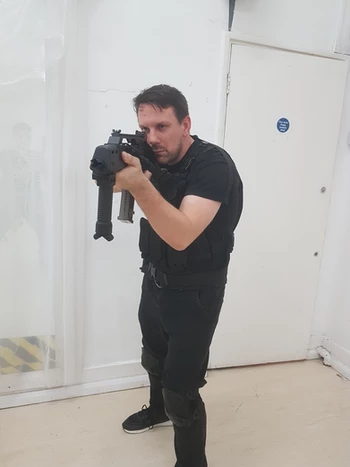
There was a real buzz around the combat aspect of the course. With the exception of myself, virtually everyone else came from a performance background and so the acting side of things was pretty straight forward for them. I always found it difficult to break down my walls at drama school, I had spent so long trying to be tough that I had forgotten how to be vulnerable. With stage combat and martial arts, I was in my comfort zone and it was perhaps the one class where I felt truly me. So on our first day of screen combat I awaited our instructor. This turned out to be Danny Baker (not that one!) a Black Belt in Shotokan Karate, who stepped into the room in full Karate Gi and who cut quite an intimidating figure. Nevertheless, with child like enthusiasm I threw myself into the exercises and proved to myself that I was far more physically capable than I ever believed before ++* So with a little encouragement from Danny I found my local Karate club. The club was held on Wednesday nights in the hall of the town church and were run by a guy whose name I can't remember. But I was learning Karate, learning to be an actor, and learning stage combat. I was happy!

I studied Karate for a year before losing interest, but a number of factors lead to this. Firstly, Danny left ISSA and was replaced by Philip D'Orleans, an instructor with the BASSC++**. Whilst Danny was geared more to the martial arts side of screen combat, Philip was more about the technical aspect of staging fights for which you really don't need to be a trained martial artist. The second factor in my leaving Karate was with the association itself. I was fast becoming aware of how easily and quickly I was advancing through the different grades. More importantly I was aware that nobody ever failed a grading and some people seemed to jump from one grade to another by missing out several grades in between. I later learned that the association had a special "instructor training course", a 2 week intensive course that could take someone with virtually no experience and train them up as an instructor. In doing so, the person in question could then go off and open their own club and make more profit for the association. Taking Karate and applying a business model similar to McDonald's, the association was the perfect fit for the now common use of the term McDojo. My Sensei at the time was a good teacher which could have been due to his previous 10 years experience with another Karate association, but when he eventually left and the club was run by someone else who was from the 2-weeks intensive school of training, I felt like my time there was done.
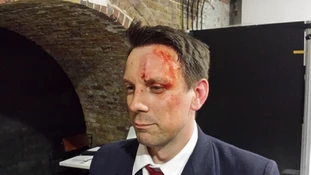
I decided to leave martial arts for a while, choosing to focus my energy on acting. Again, martial arts patiently waited for me to return. After leaving drama school I quickly got a job with a touring pantomime company and worked on several short films. But getting acting jobs is hard so I joined my local gym to keep me active during down periods in work. There I connected with an old school friend of mine and we would regularly meet up, either to lift weights, do some cardio, or go for a swim. In most gyms, you're assigned a personal trainer who can show you how to use the equipment and give you advice on how to achieve your goals. My buddy and I were assigned an instructor called Richard Gordon. Like all instructors, Richard had a bio written on the wall with his sports background and from this I learned that he was a black belt in Kung Fu and Chinese Boxing. Feeling like I was missing the martial arts a lot, my buddy and I pulled Richard to the side one day and asked if he would teach us. Richard agreed on the understanding that we would earn our grades and not go belt chasing. In the movie The Mask of Zorro (1998) an ageing Diego de la Vega (played by Anthony Hopkins) tells his protégé, played by Antonio Banderas; "When the pupil is ready the master will appear." Finally I had found a teacher who shared my views, that the martial arts are about learning and progression and not profiteering. My training in Kung Fu began in 2007 and I have not stopped since.
With my passion for martial arts reignited, I decided that I would also return to stage combat. As an actor it's always worth having special skills that you can use to help you get work, even if it's not necessarily being centre stage. I found a local group in London called Independent Drama run by Dan Styles and Ronin Traynor. These guys are the best of the best in my opinion and it's fair to say that they've more or less taught me everything I know about stage combat. The great thing about them is that they run their own fight unit and will often suggest people that they've trained themselves because they know that that person can do the job. Thanks to them I've been able to work on some great productions as a fight performer and with their courses I am constantly pushing myself out of my comfort zone and doing more amazing things. I even recently got to try my hand at stunt driving.
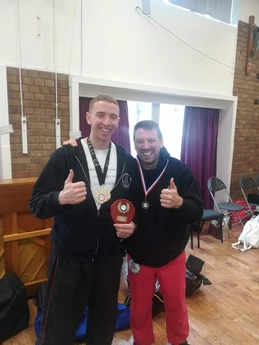
So thanks to martial arts and stage combat I have made many friends over the years. The thing about martial arts is that it asks you to make a life long commitment and pushing yourself to grow and be better. I often say that martial arts isn't something you do, it's a part of who you are. Literally everything in my life that I value comes back to the martial arts. If it wasn't for the experience I had assisting Richard with teaching his younger students I may have never got the job at Mad Science where I have met some of my nearest and dearest friends. Without marital arts I would never have gotten through Lockdown. I use martial arts to stay fit, it clears my mind when I'm feeling down, it's where I find confidence when I'm having doubts.
I sometimes wonder what teenage me would think if he knew that I was who he would become...and I think in all honesty, he'd be pleased.
Footnotes
*In case you're one of those rare people who has no idea what I'm talking about, these games enabled players to pick a character each and battle it out in a martial arts competition.
** I'm often reminded of times in TV shows when a hero seems to be able to win any fight with a single "trademark" move that looks a little martial arty. A classic example of this is seen in the TV series "Quantum Leap". Time travelling scientist Dr Sam Beckett (played by the hugely talented actor, Scott Bakula) was able to end any fight with any opponent by simply using a spinning outward crescent kick.
*** In later years I discovered that Dolph Ludgren was a student of Kyokushin Karate and earned his 2nd dan black belt in 1978.
+ Imagine a skinny little teenager topless in his bedroom lifting weights to the soundtrack from "Rocky IV" and you start to appreciate the comedy of the situation.
++ Released in 1973, Bruce Lee plays a Shaolin Monk who is invited to a Martial Arts tournament on a remote island by the film's villain, Mr. Han. In a bid to gather evidence that Mr. Han is engaged in drug smuggling and human trafficking, intelligence officer Mr. Braithwaite asks Lee's character (called rather unimaginatively "Mr Lee") to accept Han's invitation. Lee does so after learning that his sister was attacked by Han's bodyguard, O'Hara, resulting in Lee's sister taking her own life to avoid being raped.
+* Despite a prolific film career as a child actor in Hong Kong, Bruce Lee only starred in four martial arts movies; The Big Boss (1970), Fists of Fury (1971), and Way of the Dragon (1972) all with the Hong Kong production company Golden Harvest. In 1973 Bruce began production on his fourth film, Game of Death, but filming was postponed when he was offered the part of Mr Lee in Enter the Dragon (1973) a joint production between Golden Harvest and Warner Bros.
+** This is also due, in part, to the fact that I had started putting on displays of my high tolerance for physical pain, something that has served me well as a fight performer.
++* By this point I was 21 years old and had always been put off studying martial arts due to a lack of gymnastic capability.
++** British Academy of Stage and Screen Combat
Comments